Clinical AI
Reduce identifier exposure before documents enter model and retrieval pipelines.
 Request a pilot conversation
Private evaluation · customer-controlled environment
Medshield runs inside the customer's VPC or on-premise environment. It produces protected files, quarantine decisions, and evidence your engineering and security teams can inspect.
Evaluation-stage software. Medshield is not clinically validated and does not establish HIPAA compliance or a Safe Harbor determination. Never send PHI through this website, email, or the pilot application.
Designed for a specific workflow
Use Medshield as a controlled preprocessing and evidence layer before clinical PDFs, scans, office files, and structured documents reach analytics, abstraction, research, or AI systems.
Reduce identifier exposure before documents enter model and retrieval pipelines.
Produce protected artifacts, audit output, and explicit quarantine decisions.
Combine machine first pass with human risk review and expected-answer fixtures.
Evaluate document-specific behavior without sending source records to a hosted service.
Deployment boundary
Self-managed: your team operates the deployment using the agreed evaluation package.
Medshield-managed: Medshield operates a single-tenant deployment inside your cloud account under approved, logged access.
Out of scope: vendor-hosted PHI processing and multi-tenant uploads.
Synthetic evidence
Every public receipt uses invented data. Customer-specific performance is measured only against an agreed fixture set and expected-answer file.
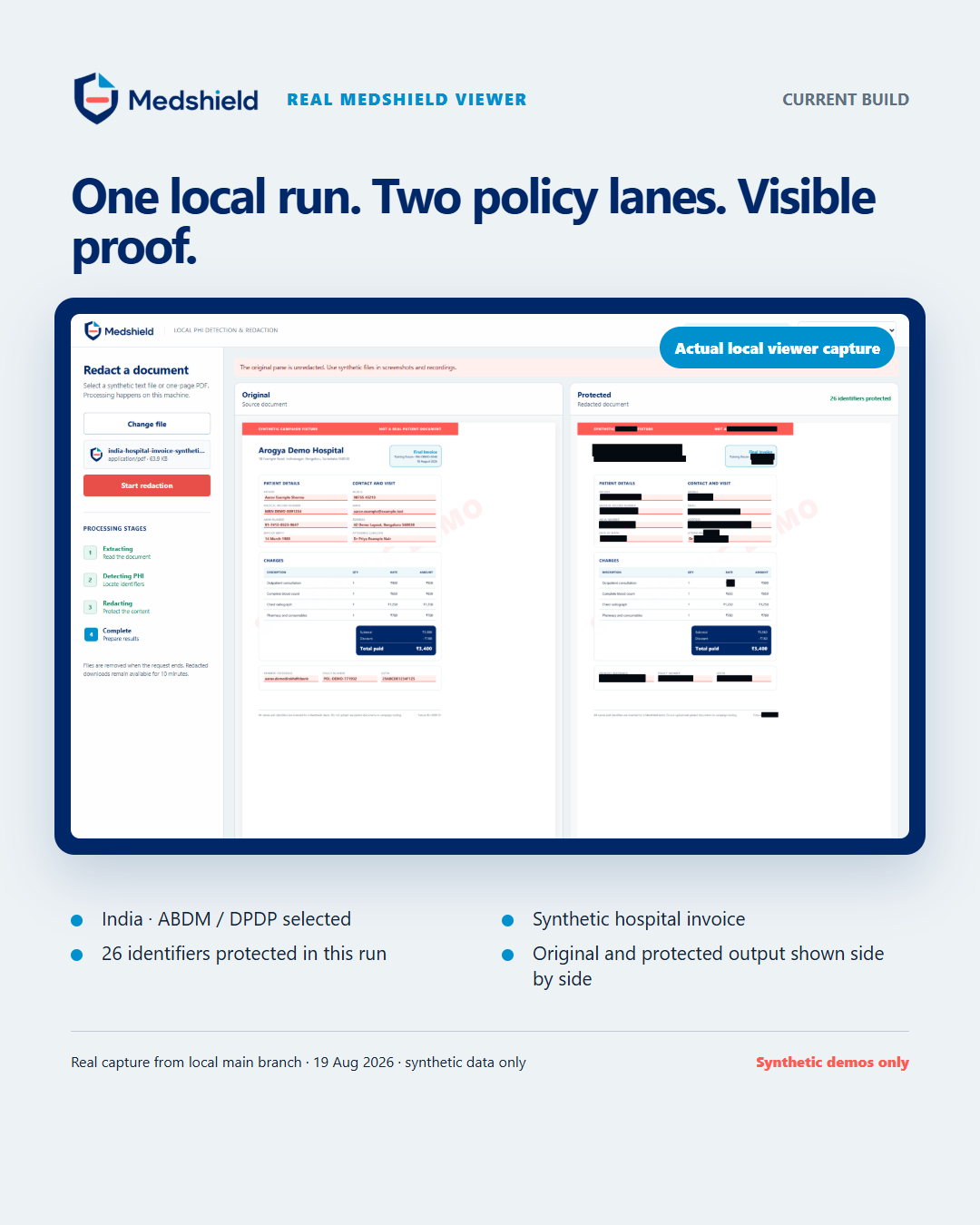
Inspect the original, protected result, processing stages, policy lane, and detected-identifier evidence together.
Proof of current product behavior on one fixture.
Protected PDFs are flattened and checked for extractable text and known literal bytes—not merely drawn over.
Proof of removal for known synthetic values.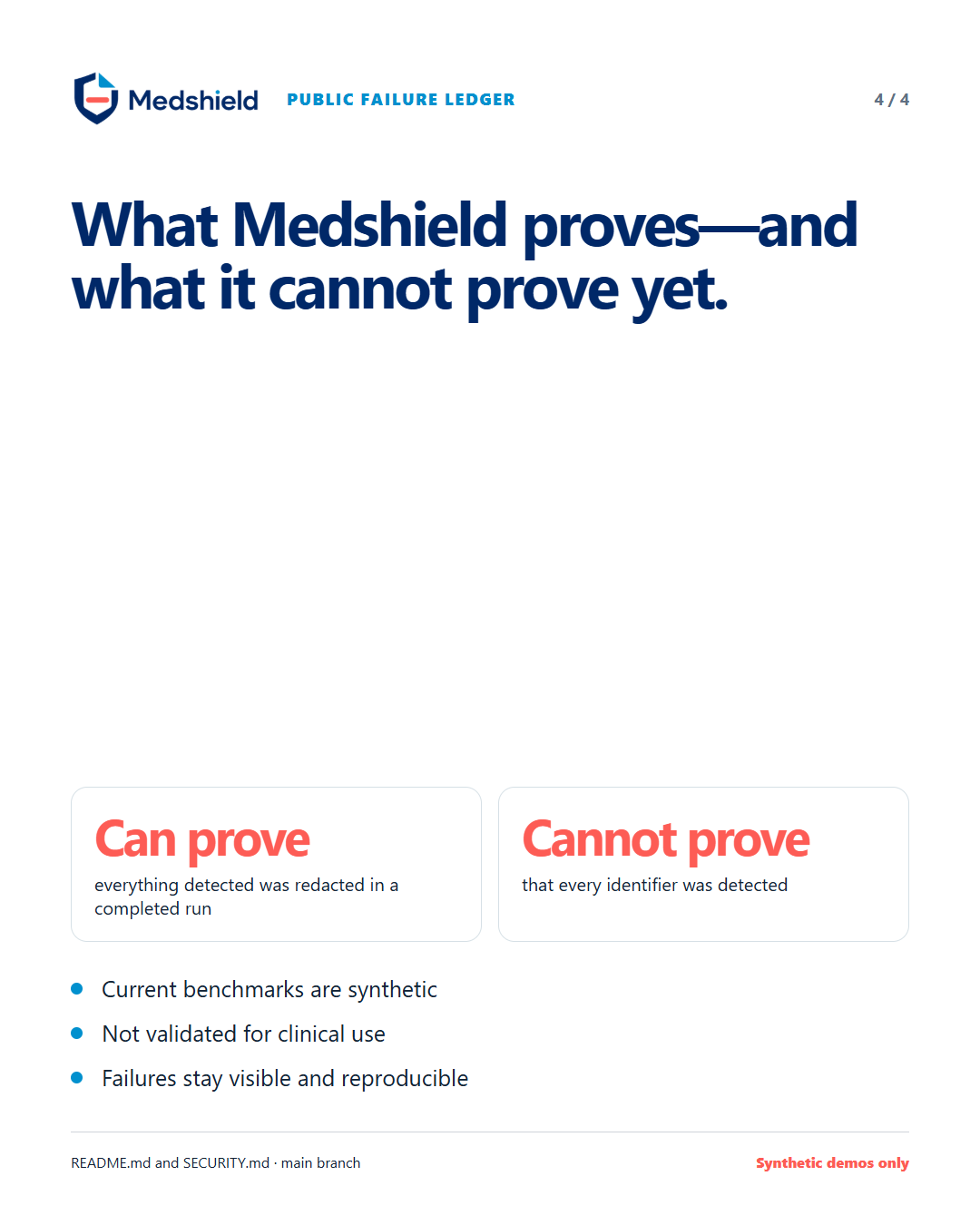
The current shorthand probe detects 10 of 13 expected identifiers. Misses remain evaluation inputs, not hidden footnotes.
Not evidence of universal recall or compliance.Operating boundary
Known gaps: handwriting, full-face photographs, signatures, DICOM, and some high-entropy identifiers.
Packaging: handling unredacted originals is an operational control outside the detector.
Validation: production recommendations require customer-specific thresholds and documented review.
Claims: no certification, universal recall, breach prevention, or freedom from human review.
Private paid pilot
Pricing is shared after qualification. The pilot has a fixed scope, written acceptance criteria, and a final proceed/remediate/stop recommendation.
Security review, architecture, SOW, data rules, and acceptance criteria.
Install inside the customer VPC or on-premise environment.
Run representative document shapes with expected answers.
Optional customer-controlled PHI stage only after the required approvals.
Metrics, failures, remediation plan, and production-readiness boundary.
Security posture
For qualified US healthcare vendors
Start with business identity and a broad workflow category. Yash reviews every request and sends the detailed questionnaire, scheduling link, or both when there is a plausible fit.
Request received
Expect a response within one business day. The next email may contain a detailed questionnaire, a scheduling link, or both. Do not send PHI or production documents by email.